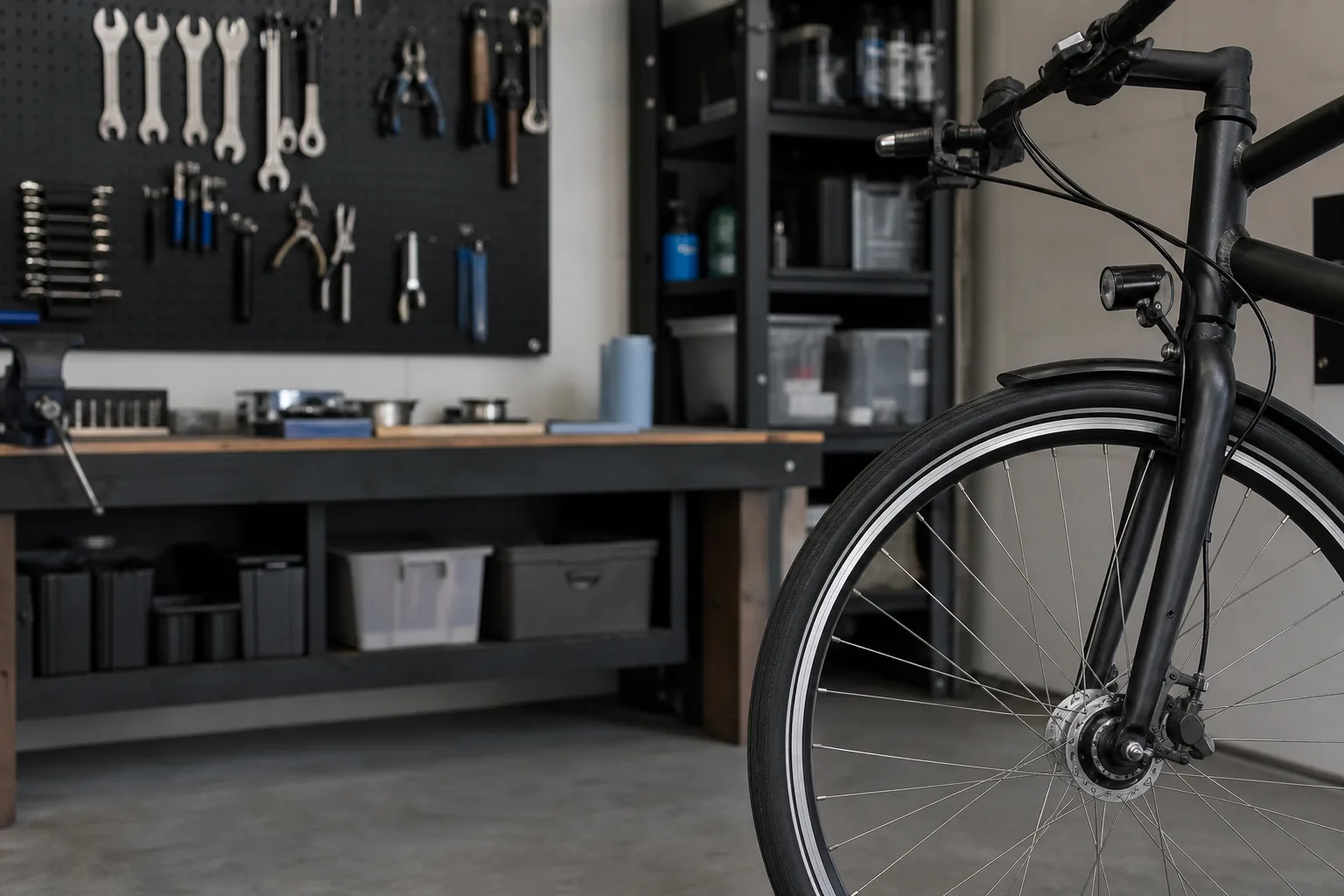
A cruiser that arrives in a carton is roughly eighty percent assembled, and the remaining twenty percent is the part that determines whether the bike is quiet and straight a year later or creaking and crooked by August. The frame, rear wheel, drivetrain and rear brake are usually done at the factory. The front wheel, handlebar, stem, seatpost, saddle, pedals and front brake are left to whoever opens the box, and those are precisely the components that carry your weight, steer, and stop you. Here is what a careful reader checks, in the order it matters.
1. What the box actually leaves undone
Cut the bands, lift the frame out, and lay the small parts on a towel before anything rolls under a shelf. Expect a front wheel that needs seating fully in the dropouts, a handlebar clamped at a rough guess of an angle, brake cables run but not tensioned, and pedals still in a plastic bag with a stamped L and R that matter enormously. The left pedal has a reverse thread. Installing it backward strips the crank arm, and a stripped aluminum crank arm is a replacement, not a repair.
2. Torque, not feel, on the parts that hold you up
Stem bolts, seatpost clamp, saddle rails and brake lever clamps all have a torque figure printed beside them or listed in the manual, usually somewhere between four and twelve newton-meters, and a small clicker wrench costs less than one shop visit. Undertightened is what actually happens to most home builds, because people are afraid of snapping something. A handlebar that rotates under a hard stop, or a saddle that noses down over a curb, is the predictable result. Overtightening a seatpost on a thin-wall aluminum frame is the other failure, and it dimples the tube permanently.
3. What comes loose in the first fifty miles
Everything settles. Cables stretch, housing beds into its ferrules, spokes take their first real load, and clamped surfaces compress a fraction. Around the fifty-mile mark, go back over the stem bolts, the seatpost clamp, the saddle clamp, the brake lever clamps, the pedal threads, and the axle nuts or quick-release levers, in that order, and expect at least two of them to take a few more degrees. Brake pads that felt fine on day one will now sit further from the rim, so the barrel adjuster comes out a turn or two. Then check the same list again at two hundred miles.
4. The upkeep a rarely ridden bike actually needs
Bikes that sit fail differently than bikes that get used. Tires lose pressure through the tube wall whether or not anyone rides, so inflate before every ride, not every month, and note that a wide cruiser tire at its low end feels flat while still holding forty pounds. Chains rust in humid garages and near salt air, so a wipe and a drop of lubricant every few weeks beats a heavy oiling twice a year. Rubber brake pads harden, cables corrode inside housing, and a leather or vinyl saddle dries and cracks if it lives in the sun.
5. What paying for assembly actually buys
A shop build costs money and buys three specific things: correct torque on every fastener, wheels trued and tensioned after the factory's quick pass, and brakes set with even pad contact and a lever that stops short of the grip. Ask whether the build includes a follow-up tune, because that thirty-day check is where the settling gets corrected. The Consumer Product Safety Commission is responsible for the federal requirements that govern how bicycles are sold and equipped in the United States, including reflectors and assembly instructions, and a shop that hands the bike over with those still in the box has skipped a step.
The bikes that stay pleasant are the ones somebody went over twice in the first month and then left alone with a pump and a rag. Neither build path is wrong. The box saves you real money if you own a torque wrench and will genuinely do the fifty-mile pass; the shop build front-loads that discipline for you.